Mar 21, 2018 | blog, marketing tips
My Top 5 Resources for Marketing and GDPR
I have spent some time working out how GDPR affects marketing, and thought some of the resources I am using might help you too. The new General Data Protection Regulation comes into force on the 25th May 2018, so it is time to take action. So here are my Top 5 GDPR and Marketing Resources
1 Information Commissioner’s Office
The ICO is responsble for regulating the new laws and there is useful guidance for businesses on their website.
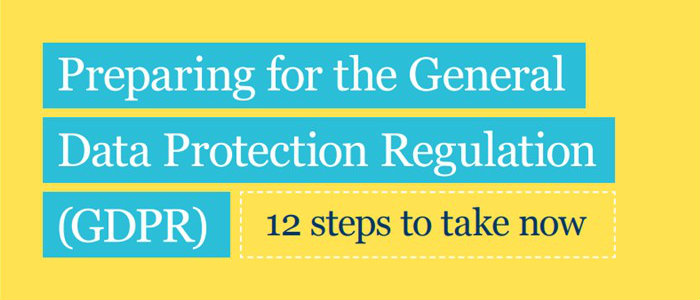
There are specific sections on how this affects small organisations here plus further information on electronic and telephone marketing, and using marketing lists. The above image is from their guide on 12 Steps to Take Now.
Pro’s – this is the original source for all information relating to GDPR
Con’s – you need to work out how to implement it for yourself
2 Hallam Internet
Nottingham based Hallam Internet has produced this simple guide to actions that marketers need to take – a great starting point covering most aspects of how GDPR affects marketing.
Pro’s – short, sharp and to the point
Con’s – not legal advice and not industry or sector specific
3 Mailchimp
If you use Mailchimp for email marketing, here is their guide to GDPR. There is also a page listing their GDPR tools.
Pro’s – reassuring to know that Mailchimp is taking GDPR seriously and will help you comply with the new rules
Con’s – only really relevant if you are a Mailchimp user! If you want to learn more about Mailchimp, check out my workshops
4 Suzanne Dibble
Small business law expert Suzanne Dibble runs a Facebook group for online entrepreneurs with videos to answer your GDPR questions. There is a list of the videos in the pinned post so you can see which relate to your type of business. Suzanne is also selling a GDPR Compliance Pack.
Pro’s – practical legal advice for free, and there are specific videos on GDPR for different types of business
Con’s – the time it takes to watch all of the relevant videos. Due to the size of the group, Suzanne cannot answer all the questions personally so you need to watch the videos
5 Hubspot GDPR Glossary
In-bound marketing experts Hubspot have produced a GDPR Glossary to help us understand the jargon.
Pro’s – explains the terminology in layman’s terms
Con’s – not exhaustive, you will need more information than this
Have you found any great resources which can help with how GDPR affects marketing? If so, please contact me so that I can add them to my list.
Please note that this blog is for information only and should not be regarded as legal advice.

Sep 19, 2017 | blog, marketing tips
There is something slightly unnerving about writing a blog post about blogging, but here goes…
Blogging has been around for 20 years, but I still get asked “Why should I be blogging”, so here are 7 reasons why your business needs a blog on its website.
- Improves your Google Ranking
Google likes fresh content, so regularly updating your blog will help your website rank higher in search results, and Google will then crawl your site more regularly too once it realises that it is being regularly updated.
It will also increase the number of pages on your website (each blog post should be a new page), which will help convince Google that yours is an important website and worth ranking more highly.
- Helps you get found on Google
If you blog about topics related to your business, you will probably use the terms that people will be looking for when searching for businesses like yours, so it will improve your SEO (Search Engine Optimisation). You can research the terms people are looking for using the Google Keyword Planner.
- Builds your Reputation and Trust
A blog gives your business the opportunity to show off their collective knowledge, which will help convert readers into buyers. It may get you other opportunities such as speaking at events too.
- Shows off your Knowledge
You are an expert in your field. None of that claiming “We are market leaders, blah blah,” you can actually show readers that you know what you are talking about.
- Tells people what you do
A good blog has lots of posts so it gives you lots of opportunities to show all of the things your business can do. Client case studies can also make great blog posts, demonstrating your knowledge, and how you go the extra mile for your clients.
- Creates Content to share on Social media
Not everything you share on social media needs to be your promoting your own business – but it is easier to promote your own business if you have blog posts which you can share on your social media profiles, whether that is Facebook, Twitter or Linkedin. Remember the 80:20 rule – around 20% of your posts should promote your business, the other 80% should be sharing information which aims to inform, educate and entertain.
- Creates Content to use in Email Marketing
A good blog works hand in hand with email marketing too. Each email newsletter can introduce the blog articles, and then link back to them.
If you need to learn more about how to blog, check out my next blogging workshop here.
Photo by Corinne Kutz on Unsplash

Apr 21, 2012 | blog, marketing mentoring, marketing tips
If like me you have been inspired by the spring sunshine to have a big de-clutter and spring clean at home, you will know what a therapeutic process it is! Once all those annoying jobs and clutter are gone, you feel inspired to make a fresh start – and the same goes for your marketing. So how do you go about spring cleaning your marketing? Here are some ideas:
1. Review your marketing materials
If it is a while since you created your website and business card, you will probably find that they are in need of an update. Do they make your USP clear? (for more on checking your USP see here). Have you got new customers that you could add to your website and ask for new testimonials?
2. Review your Social Media Profiles
Are your Twitter and Linked-in profiles up to date and complete, with all your qualifications and experience? Is it clear what you are offering? Do you have a good up to date photo of yourself on there? Do you need to get some more recommendations on Linked-in? Get in touch with your happy customers and ask for some testimonials. Have you set up your Facebook business page for the new Timeline yet?
3. Update your records
If there is a pile of business cards lurking in the corner of your office, now is the time to add them to your database so that you can bin those cards. Think about keeping separate lists of clients, prospects and referrers, so that you can target them with separate communications. If you don’t have a database, then you can create a simple one using a spreadsheet with separate columns for first name, second name, company, address, phone number and email. This can then be uploaded to an email marketing system such as Mailchimp (for more on email marketing, see here). You could also connect with them on Linkedin – that way you can stay in touch even if they move jobs or company. Linkedin also allows you to download all your contacts which could then form the basis of a database.
4. Check your SEO
Once you have updated the content on your website, do an SEO (search engine optimisation) spring clean. There are a lot of factors involved in SEO, but at least check that the page title on each page (that is the one on the tab at the top) contains useful information for anybody searching for your company, your name, and what you offer. (on this page it is Spring Clean Your Marketing | Ridgeway Marketing). It should reflect the same words used in the text on the page – too many waste this title on words such as “Home” or “Services”. If most of your customers are local, have you registered on Google My Business? This is a free Google service and will help with local SEO. Also think about getting links on high ranking sites.
5. Review your marketing activities
If this is the end of your financial year, now is a good time to review your marketing activities to see what is working and what is not. Think about it in terms of cost and time, and the value of the business (and profit) each activity generates. You also need to consider the Lifetime Value of the customer – though it may cost a lot to get one customer, if they stay with you, what is the Lifetime Value of that customer? This might lead you to re-consider how much time and money you spend on each area of marketing.
6. Get an outside viewpoint
Most of us just get too close to our own business to see the wood for the trees, so do ask a trusted friend or colleague for an outside viewpoint. They may spot something that you just cannot see. A marketing mentor can help you with a fresh perspective on your marketing, and give you lots of new ideas on how to market your product or service – for more details on Marketing Mentoring, see here
Author: Beryl Pettitt
Ridgeway Marketing provides Marketing Mentoring and Marketing Training to small businesses and organisations across the UK. Beryl Pettitt has worked in marketing for over 25 years, and her experience spans both the corporate environment and running her own business. She understands the needs and pressures of managing a business, so clients find her advice both practical and affordable. If you would like some help spring cleaning your marketing, request a free one hour marketing mentoring session.
www.ridgewaymarketing.co.uk Tel 0115 772 2518

Aug 10, 2011 | blog, marketing tips, marketing training
If you are not keeping in touch with your clients, or have a pile of business cards from networking events and exhibitions, it is time to give some serious consideration to email marketing.
Email marketing is an extremely cost effective way of getting more business from your existing clients and from new contacts. By sending useful information in personally addressed emails, you can build a relationship with them and keep you business front of mind, so that next time they need to purchase, it will be from you.
Many companies think that the emails just get deleted – but just think how much it will cost when they bin your expensive leaflet! You may think response rates are low for both emails and postal mailings – below 10% and often under 1% – but if you consider the cost of adverts, then you can see that emailing is very cost effective.
So here are 6 simple steps to effective email marketing:
Step 1 – use a reputable email marketing service
When companies try email marketing, they often use email software such as Microsoft Outlook, with a PDF of their brochure attached. This gives them no feedback on who is opening which parts of their email and brochure. Worse, they risk being reported as Spammers, and their business email address getting blacklisted by ISPs. An email marketing service such as Mail Chimp or Constant Contact will cost you very little, and will avoid all these problems.
Step 2 – build your own list
You probably already have the basis of a great list – your existing contacts and clients. If you don’t have a system for storing these, start by putting all their contact details in a spreadsheet, using a separate column for first name, last name, company name, address, post code and email address.
Step 3 – develop relevant and useful email content
The trick to improving response rates is to personalise the content and get the reader’s attention quickly. Offer something they want and is useful – and strangely this may not initially be your products or services! It could be something free – perhaps a buying guide, or an update on the latest trends.
Step 4 – write an attention grabbing headline
The headline will be critical in getting the reader’s attention, so give as much thought as you can to this. Remember that words like Free tend to get your email labelled as Spam, and good email software will test your email text to check that it is not likely to happen.
Step 5 – sort your list into groups
Segmenting your list, so that you have a different list for each customer group, will help you send more relevant information to your contacts, and improve your response rate. If you ever buy from Amazon, you will be familiar with this – each email they send you features products related to those you have bought in the past – books by the same author, toys aimed at the same age group etc…
Step 6 – analyse the results and act on them
Using an email marketing service will enable you to see which contact has clicked on which parts of your email. You can then use this information to follow up with targeted emails or phone calls (but probably best not to mention that you can see what they have clicked on – it can look like stalking!). You can also use it to test different styles and content, to see what gives the best response rates.
You can keep building your list – remember to ask for permission to email, and have an opt out message on your emails too.
If you would like to learn more about Mailchimp, look out for our beginners Mailchimp workshops – more details here
Author: Beryl Pettitt
